THIS PAGE IS HELPFUL
INFORMATION THAT WE FEEL PARENTS SHOULD HAVE FOR THE WELFARE OF THEIR CHILDREN
Some of the tips for kids are
part of our new Think Safety, Grow Happy! show which includes Playground and Workzone Safety, Fire Safety and Stranger Danger Messages. This is all presented
in a fun interactive way with Puppets and Music.
What can parents do to help
protect their children?
- Know where your children are at all times.
- Never leave children alone in cars.
- Establish a special code word with your child that only you and
your child knows.
- Teach your child not to tell anyone the special code word, (don t
YOU tell it to anyone either).
- Establish a routine for picking your children up from school or
other events and tell your children not to leave with anyone else unless
they know your special code word.
- Make sure they know that even if the person is not a stranger they
still must know the code word no matter what else they tell them. (Remember the majority of children that
are abducted are taken by people that they know.)
- Teach your child their full name, address and phone number (with area code).
- Teach your child how to reach you, the police or another adult in
cases of emergencies. Even small children can dial 911.
- Tell your children about abductions in simple and easy to
understand terms. Awareness can help them protect themselves.
- Cover all unused outlets in your home with plastic plugs.
- Never put your car in drive until you are sure all children are buckled in.
- Have home fire drills, so everyone knows how to get out fast.
- Check batteries in smoke detectors and carbon monoxide detectors.
- Listen when your children discuss anyone they've encountered in
your absence.
- Organize your child's photo and descriptive data.
- Have a good photo of your child taken at least every 6 months.
- Never take your child out in public wearing anything with their
name printed on it, clothing, jewelry, lunchboxes, toys.
How can you tell if a child is
being sexually abused?
- Changes in behavior, extreme mood swings, withdrawal,
fearlessness, excessive crying.
- Bed-wetting, nightmares, fear of going to bed and sleep disorders.
- Acting out inappropriate sexual activity or showing unusual
interest in sexual matters.
- A sudden acting out of feelings or aggressive, rebellious
behavior.
- Regression to infantile behavior.
- A fear of certain places, people or activities.
- Pain, itching, bleeding, fluid or rawness in the private areas.
What you should teach you
children to do to ensure their own safety.
- Always tell your parents where you are or where you are going.
- Create a secret code word with your parents, one that only you and
your parents know.
- Never go with anyone that doesn t know the code word, even if it
is someone you know.
- Stay close to your parents in public areas. If you are separated
go directly to the nearest store and tell the clerk you are lost. Have
them call your parents over the loudspeker.
- If anyone tries to hurt you, yell FIRE and HELP and fight. (People
are more likely to look if you yell Fire then if you just yell help).
- Never hitch-hike.
- Don't go to restrooms in out-of-the-way places without an adult.
- Don't take short cuts. Always use well-traveled streets.
- Never go to playgrounds or movies alone.
- Stay away from isolated areas or abandoned buildings.
- Don't tell anyone on the phone that your parents are not home.
Instead tell them that your parents can't come to the phone and take a
message.
- Don't let strangers into the house when your parents are not home.
- Run away from any car that slows down or stops by you. Go quickly
to the nearest safe house or your own home. Do not run and hide! Go to a
public place.
- If you see someone hanging around a schoolyard or a park, try to
remember as much about the person as you can and tell you parents.
- Do not approach adults who ask you for directions. Adults should
ask other adults for directions. Step back, tell them you don't know and
walk away.
- Tell parents immediately if an adult offers you a gift or a job,
even if you know them. Never leave with anyone without permission from
your parents.
- If someone touches you in a way that feels bad or uncomfortable,
tell them in a loud voice that it is your body and they don't have the
right to touch you, even if it is a relative or friend. Tell an adult you
can trust and keep telling until someone believes you.
- Don't believe any adult who asks you to keep a secret from your
parents.
Teach your kids the ten tricks
strangers (or people they know) use to lure children.
- A stranger may pose as an authority figure (police, firemen,
security) and ask the child to leave with them.
- A stranger may try to bribe the child with money, candy, toys,
small animals etc.
- A stranger may tell the child there is a crisis such as family
illness and say a parent told them to pick the child up (always have a
code word that only parent and child know and don't go with anyone that
doesn't know the word).
- A stranger may approach threateningly, such as with a weapon or
threat.
- A stranger may approach with compliments to appeal to child's ego.
- A stranger may approach with false caring, promise or knowing
child's name if noted on child's possessions (shirt, lunchbox, toy).
- A stranger may suggest playing games. Games should never make a
child feel uncomfortable.
- A stranger may ask for help, such as directions or to help find a
lost pet.
- Children often idolize adults, allowing false trust. Strangers prey on this false trust.
- A stranger may try to lure a child by asking the child to do work for the stranger.
Preventative measures
Name tags on clothing
or items that your child carries should be put in an area where they cannot be
easily seen by a passing observer.
Stress "Safety in
Numbers". A sex offender or pedophile often singles out a lone child or
one that is out late at night alone.
A perpetrator singles
out a child or teen that seems to appear to have problems at home. An at-risk
child or teen is easily identified and pursued.
Explain to your
children that not all people are bad. Most people genuinely care about
children, but that caution and prevention are the tools that must be used.
Listen to your child.
Take time everyday to sit and talk with your child or teen and make sure that
they feel at ease with you to discuss their fears and are able to communicate
serious abuses with you.
Urge your child to
think escape / survival if he or she were ever abducted. Promote thinking
skills.
Speak to your local
law enforcement agency to find out about neighborhood watch. If neighborhood
watch is not in your area, ask your police department how to start a program.
Get involved!
Check with your local
law enforcement to find out if there are sexual offenders in your area. You and
your children will then know who to stay away from.
Beware! Most child
predators are known to the child they victimize. Offenders usually befriend
their victim.
Children need to be taught the limits of acceptable behaviors in adults and their peers.
Children must be able
to recognize dangerous situations and how to seek safety whomever they are
with.
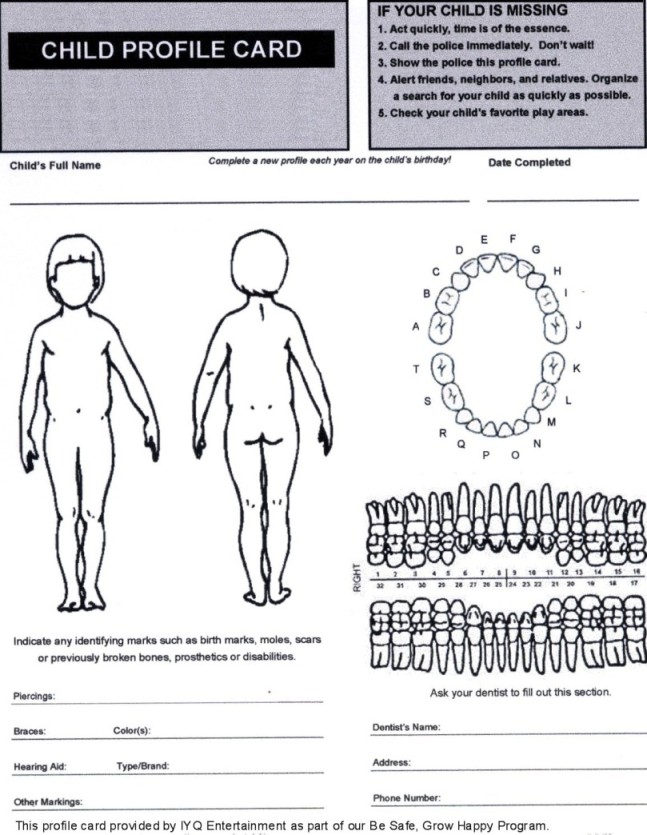
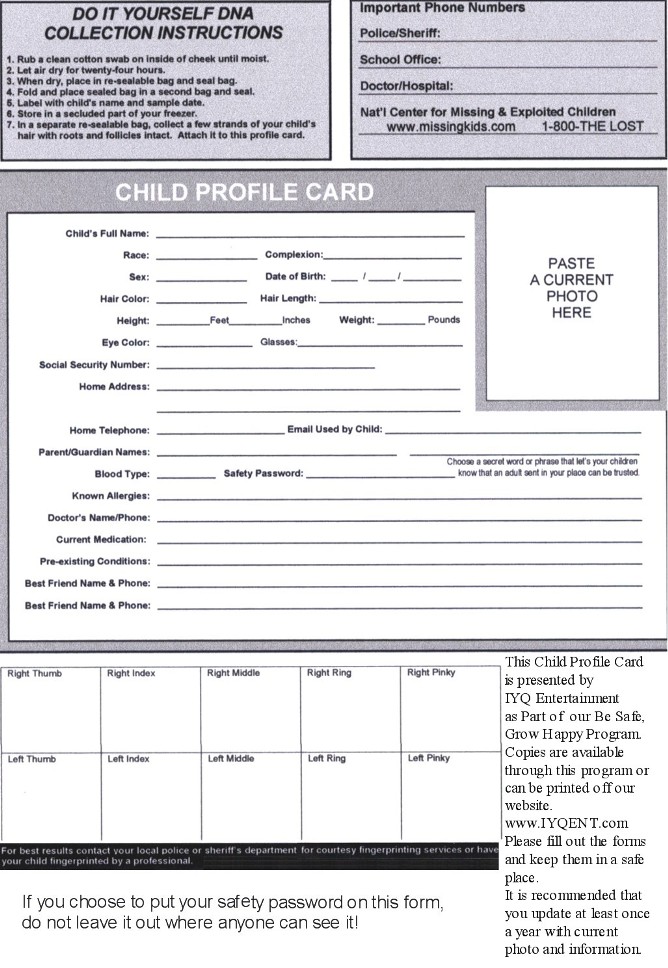
The following are forms that you can print out to keep track of vital informantion on your children. We here at IYQ Entertainment hope you never need this informantion.
Click on the forms to enlarge them, then print.